
4 Best Routers for Verizon Fios in 2026
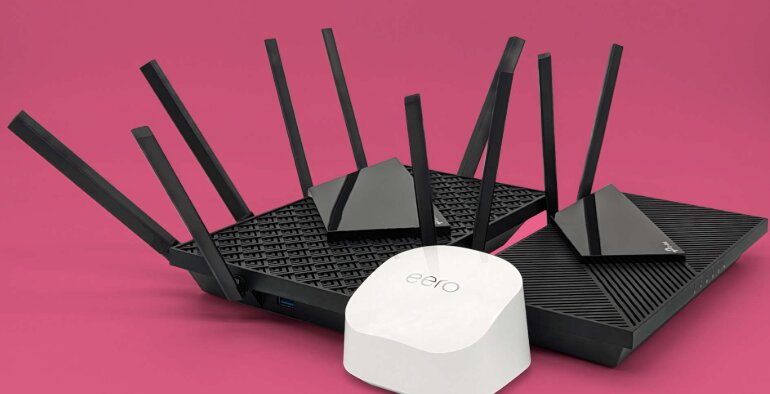
Verizon Fios delivers some of the most reliable fiber internet in the United States, but the router you pair with it plays a major role in your real-world experience. Even with gigabit or multi-gig fiber, an underpowered router can create bottlenecks, weak coverage, and inconsistent performance across devices.
This becomes especially noticeable in modern homes where streaming, gaming, video calls, smart home devices, and cloud backups all run at the same time.
After evaluating performance across WiFi standards, mesh capability, device handling, latency, and fiber optimization, a few routers clearly stand out as the best options for Verizon Fios users in 2026.
The focus here is simple: maximizing what Fios already delivers without introducing wireless limitations.
Our Top Recommendation: NETGEAR Orbi 770 Series WiFi 7 Mesh System
The NETGEAR Orbi 770 Series is the most complete router solution for Verizon Fios users who want consistent, whole-home performance without dead zones or signal drops.
It is a tri-band WiFi 7 mesh system designed specifically for high-density environments where multiple users and devices are active simultaneously. Instead of relying on a single broadcast point, it distributes traffic across multiple nodes, ensuring that performance remains stable throughout the home.
What makes it especially effective for Fios is its ability to handle multi-gig speeds while maintaining consistent latency. Fiber internet often exposes weaknesses in older routers, but the Orbi 770 is designed to scale with those speeds rather than restrict them.
The system is also engineered for device-heavy households. Whether it is streaming 4K video in multiple rooms, running smart security cameras, or handling simultaneous gaming sessions, the Orbi 770 maintains consistent throughput across all connected devices.
Its WiFi 7 implementation also means it is future-ready for upcoming Fios upgrades and next-generation devices that demand higher bandwidth and lower latency.
For users in medium to large homes, especially multi-floor layouts, this system removes the common frustration of weak upstairs or far-room coverage entirely.
Bottom line: The Orbi 770 is the most balanced and reliable option for maximizing Verizon Fios performance across an entire home.
Best Router for Verizon Fios: Top 5 Detailed Picks
Below are the best routers that pair exceptionally well with Verizon Fios connections, each selected for a specific use case including performance, value, coverage, and flexibility.
1. NETGEAR Orbi 770 Series – Best Overall Router for Verizon Fios
NETGEAR Orbi 770 Series WiFi 7 Mesh System (RBE773)
Pros
- True whole-home WiFi coverage with mesh architecture
- WiFi 7 support with very high theoretical throughput
- Excellent stability under heavy device loads
- Strong performance across large and multi-floor homes
- Designed for multi-gig internet plans
- Automatic firmware updates and built-in security features
Cons
- Premium price point
- More hardware than needed for small apartments
Specifications
| Feature | Details |
|---|---|
| WiFi Standard | WiFi 7 (Tri-Band Mesh) |
| Maximum Speed | Up to 11Gbps |
| Coverage | Up to 8,000 sq. ft. (system dependent) |
| Device Capacity | Around 100 devices |
| Internet Port | 2.5 Gig |
| System Type | Router + satellite mesh units |
The Orbi 770 Series is built around the concept of eliminating WiFi dead zones completely. Unlike traditional routers that broadcast from a single point, this system uses multiple units placed throughout the home to create a unified network.
In real-world Verizon Fios usage, this difference is significant. Fiber internet provides extremely high speeds at the source, but those speeds often degrade with distance and walls. The Orbi system addresses this by keeping devices connected to the nearest node, rather than forcing them to rely on a distant central router.
One of its strongest advantages is consistency under load. Many homes now operate dozens of devices at once, and traditional routers often struggle when bandwidth demand spikes. The Orbi system distributes traffic intelligently, preventing congestion and maintaining stable performance across devices.
It also supports WiFi 7, which improves efficiency in crowded wireless environments and reduces latency for gaming and video calls.
For large homes, multi-family setups, or users who simply want uninterrupted coverage everywhere, this is the most complete solution available.
Bottom line: The Orbi 770 is the best overall Verizon Fios router system for whole-home stability and performance.
2. NETGEAR Nighthawk RS700S – Best High-Speed Single Router for Verizon Fios
NETGEAR Nighthawk Tri-Band WiFi 7 Router RS700S
Pros
- Extremely high WiFi 7 throughput performance
- Strong low-latency performance for gaming
- 10 Gig internet port for multi-gig Fios plans
- Compact single-router design
- Excellent performance for dense device environments
Cons
- No mesh expansion included
- Coverage limited compared to multi-node systems
Specifications
| Feature | Details |
|---|---|
| WiFi Standard | WiFi 7 (Tri-Band) |
| Maximum Speed | Up to 19Gbps |
| Coverage | Around 3,500 sq. ft. |
| Ports | 10 Gig WAN + LAN support |
| System Type | Standalone router |
The Nighthawk RS700S is designed for users who prioritize raw performance over whole-home distribution. It delivers some of the highest theoretical wireless speeds available in a consumer router, making it especially appealing for users on Verizon Fios gigabit and multi-gig plans.
Unlike mesh systems, all traffic is handled by a single centralized device. This reduces complexity and can slightly improve latency in gaming or time-sensitive tasks because there is no inter-node communication overhead.
Its 10 Gig internet port ensures it will not bottleneck even future Fios upgrades beyond standard gigabit plans.
However, the tradeoff is coverage. While it performs extremely well in open layouts or medium-sized homes, signal strength will naturally degrade in larger or multi-floor environments compared to mesh systems.
This router is ideal for users who want maximum speed in a single location or who already have a structured home with minimal WiFi obstacles.
Bottom line: The RS700S is the best single-router performance option for Verizon Fios users.
3. TP-Link Archer AXE75 – Best Value WiFi 6E Router for Verizon Fios
TP-Link Archer AXE5400 WiFi 6E Router (AXE75)
Pros
- Strong performance at a mid-range price point
- WiFi 6E with dedicated 6GHz band
- Reliable for 1Gbps Fios plans
- Built-in VPN support
- Good thermal and hardware design for stability
Cons
- Not WiFi 7
- Lower peak performance compared to premium routers
Specifications
| Feature | Details |
|---|---|
| WiFi Standard | WiFi 6E (Tri-Band) |
| Maximum Speed | Up to 5400 Mbps |
| Frequency Bands | 2.4GHz, 5GHz, 6GHz |
| CPU | 1.7GHz Quad-Core |
| Security | WPA3 + HomeShield |
The Archer AXE75 is one of the most practical routers for Verizon Fios users who want strong performance without entering premium pricing territory.
Its biggest advantage is the inclusion of the 6GHz band, which significantly reduces congestion compared to traditional dual-band routers. In dense WiFi environments such as apartment buildings or neighborhoods with overlapping networks, this improvement can be noticeable in both speed stability and latency.
For most users on 300 Mbps to 1 Gbps Fios plans, the AXE75 provides more than enough performance for streaming, gaming, and remote work.
It also includes VPN capabilities, making it suitable for users who want secure remote access or encrypted browsing without additional hardware.
While it does not match WiFi 7 routers in raw performance, it delivers excellent real-world value and reliability.
Bottom line: The AXE75 is the best balance of price and performance for Verizon Fios users.
4. GL.iNet GL-BE3600 (Slate 7) – Best Portable Router for Verizon Fios Users
GL.iNet GL-BE3600 Slate 7 Portable WiFi 7 Router
Pros
- Portable WiFi 7 travel router design
- Advanced VPN support (WireGuard and OpenVPN)
- Touchscreen control interface for easy management
- Dual 2.5G Ethernet ports
- Highly customizable OpenWrt-based system
Cons
- Not designed for whole-home coverage
- Limited range compared to full-size routers
Specifications
| Feature | Details |
|---|---|
| WiFi Standard | WiFi 7 |
| Dual-Band Speed | 688 Mbps + 2882 Mbps |
| Ports | 2 x 2.5G Ethernet |
| Software | OpenWrt 23.05 |
| VPN | Client and server support |
The Slate 7 is not a traditional home router, but it plays a very specific and valuable role in the Verizon Fios ecosystem.
It is designed for portability, advanced networking control, and secure connections in environments where flexibility matters more than coverage.
One of its strongest features is its built-in VPN system, which allows users to encrypt traffic or route through secure networks without requiring external software. This makes it useful for business travel, temporary setups, or privacy-focused configurations.
Its touchscreen interface also makes network management significantly more accessible compared to traditional router dashboards.
Because it is based on OpenWrt, it is highly customizable, allowing advanced users to configure routing, firewall rules, and network behavior in detail.
However, it is not intended to replace a full home router in a Verizon Fios household. It works best as a secondary or travel-based solution.
Bottom line: The Slate 7 is the best portable and VPN-focused router option for Verizon Fios users.
Why Mesh vs Single Router Matters for Verizon Fios
One of the most important decisions when choosing a router for Verizon Fios is whether to use a single-router setup or a mesh system.
Single routers like the Nighthawk RS700S deliver excellent raw performance but rely on a central broadcast point. This works well in smaller homes or open layouts.
Mesh systems like the Orbi 770 distribute coverage across multiple units, ensuring consistent performance across walls, floors, and long distances.
For most Fios users in larger homes, mesh systems generally provide a more stable experience even if peak speeds are similar.
Verizon Fios Router Compatibility Explained
One of the most important considerations when choosing a router for Verizon Fios is compatibility. The good news is that Verizon Fios is one of the most flexible internet services when it comes to third-party networking equipment.
Unlike some cable providers that rely heavily on proprietary modem-router combinations, Verizon Fios uses a fiber optic line that terminates at an Optical Network Terminal (ONT). This ONT acts as the bridge between Verizon’s fiber infrastructure and your home network.
In most modern installations, the ONT outputs internet through an Ethernet port. This means any standard router can connect directly without special configuration. Once connected, your router becomes the primary device responsible for managing WiFi, device traffic, security settings, and network performance.
In older homes, some setups may still use a coaxial connection (MoCA) between the ONT and router. While this can sound complex, it is still fully compatible with third-party routers and can usually be converted to Ethernet with a simple configuration change or technician adjustment.
The key takeaway is that Verizon Fios does not restrict router choice. This allows users to upgrade freely to high-performance WiFi 6E and WiFi 7 routers like mesh systems or gaming-focused standalone units without compatibility concerns.
For users considering upgrades, this flexibility is one of the biggest advantages of Fios compared to other ISPs.
Do You Need a Separate Modem for Verizon Fios?
A common point of confusion for users switching to Verizon Fios from cable internet providers is whether a modem is required. The answer is simple: no separate modem is needed.
This is because Verizon Fios does not use a traditional cable modem system. Instead, fiber optic signals are converted into Ethernet by the ONT installed in your home. The ONT performs the function that a modem would normally handle in cable internet setups.
As a result, your network setup is significantly simplified. You only need a router connected directly to the ONT via an Ethernet cable. From that point, the router handles all WiFi distribution and network management.
This setup has several practical advantages. First, it allows you to invest fully in a higher-quality router instead of splitting your budget between a modem and router. Second, it reduces potential points of failure in your network chain, improving overall stability.
Most modern routers included in this guide—whether mesh systems like the NETGEAR Orbi 770 Series or standalone units like the NETGEAR Nighthawk RS700S—connect directly to the ONT without any additional hardware.
For users upgrading from cable internet, this is one of the most noticeable improvements in simplicity and flexibility.
Mesh vs Single Router for Verizon Fios (Detailed Breakdown)
Choosing between a mesh system and a single router is one of the most important decisions when optimizing Verizon Fios performance.
Single Router Setup
A single router setup relies on one central device to broadcast WiFi throughout the home. High-performance routers like the NETGEAR Nighthawk RS700S can deliver extremely fast speeds and low latency in areas close to the router.
This setup works best in:
- Small to medium-sized homes
- Apartments with open layouts
- Users who prioritize gaming performance
- Environments with fewer walls or obstructions
The main advantage of a single router is simplicity and slightly lower latency since all traffic is handled by one device. However, performance naturally decreases with distance, and walls or floors can significantly weaken signal strength.
Mesh WiFi System
Mesh systems like the NETGEAR Orbi 770 Series use multiple units placed around the home to create a unified wireless network. Devices automatically connect to the nearest node, ensuring consistent performance regardless of location.
This setup is ideal for:
- Large homes
- Multi-floor properties
- Homes with dead zones
- Households with many connected devices
Mesh systems significantly improve coverage consistency, although they may introduce slightly more complexity during setup. However, modern mesh systems are highly optimized, and most operate seamlessly after initial configuration.
For Verizon Fios users, mesh systems often provide the most reliable real-world experience because fiber internet speeds remain stable across the entire home rather than being concentrated near a single point.
In most large households, mesh systems outperform single routers in overall usability, even if peak speeds are similar.
Key Features to Prioritize in a Verizon Fios Router
When selecting a router for Verizon Fios, focusing on the right features is more important than simply choosing the highest advertised speed.
Multi-Gig Ethernet Ports
Verizon Fios offers plans that exceed standard gigabit speeds in some areas. To fully utilize these plans, a router with 2.5G or 10G Ethernet ports is essential. Without this, wired performance may become the bottleneck even if WiFi is fast.
WiFi 6E or WiFi 7 Support
WiFi 6E introduces the 6GHz band, which reduces congestion and improves performance in crowded environments. WiFi 7 goes further by improving efficiency, reducing latency, and increasing overall capacity for multiple devices.
For users with modern smartphones, laptops, and smart home devices, these standards significantly improve real-world performance.
High Device Capacity
Modern homes often include dozens of connected devices. This includes phones, laptops, smart TVs, security cameras, and IoT devices. A router with strong device-handling capability ensures stable performance even under heavy load.
Mesh systems and high-end WiFi 7 routers typically handle device congestion far better than older WiFi 5 models.
Quality of Service (QoS)
QoS allows the router to prioritize specific types of traffic. For example, video calls and gaming traffic can be prioritized over background downloads. This results in smoother performance during high-demand usage.
Mesh Expandability
Even if you start with a single router, having the option to expand into a mesh system later provides long-term flexibility. This is especially useful for users who may upgrade homes or experience coverage issues later.
WPA3 Security
Modern routers should support WPA3 encryption, which provides stronger protection against brute-force attacks and improves overall network security. This is especially important for households with multiple connected devices.
Final Note on Choosing the Right Setup
The best Verizon Fios router setup depends heavily on your home layout and usage habits. While high-speed routers like the Nighthawk RS700S deliver excellent performance in compact spaces, mesh systems like the Orbi 770 Series are more effective for full-home coverage.
Understanding compatibility, modem requirements, system type, and key hardware features ensures that your Verizon Fios connection performs at its full potential without unnecessary bottlenecks.
Final Verdict
Choosing the best router for Verizon Fios depends on your home layout, number of connected devices, and performance expectations.
After comparing all options, the clear top choice is:
NETGEAR Orbi 770 Series WiFi 7 Mesh System
It delivers the most complete Verizon Fios experience by combining:
- Whole-home coverage
- High-speed WiFi 7 performance
- Strong multi-device handling
- Stable performance under load
- Future-proof multi-gig support
For users who prefer a single high-performance router, the NETGEAR Nighthawk RS700S is the strongest alternative.
The TP-Link Archer AXE75 offers excellent mid-range value, while the GL.iNet Slate 7 serves a specialized role for portability and VPN networking.
In the end, the best Verizon Fios router is the one that fully unlocks your fiber connection without creating wireless bottlenecks, whether through raw speed or complete home coverage.